Two component pseudo-Nambu-Goldstone-boson dark matter

 Prediction of viable parameter space.
Abstract +
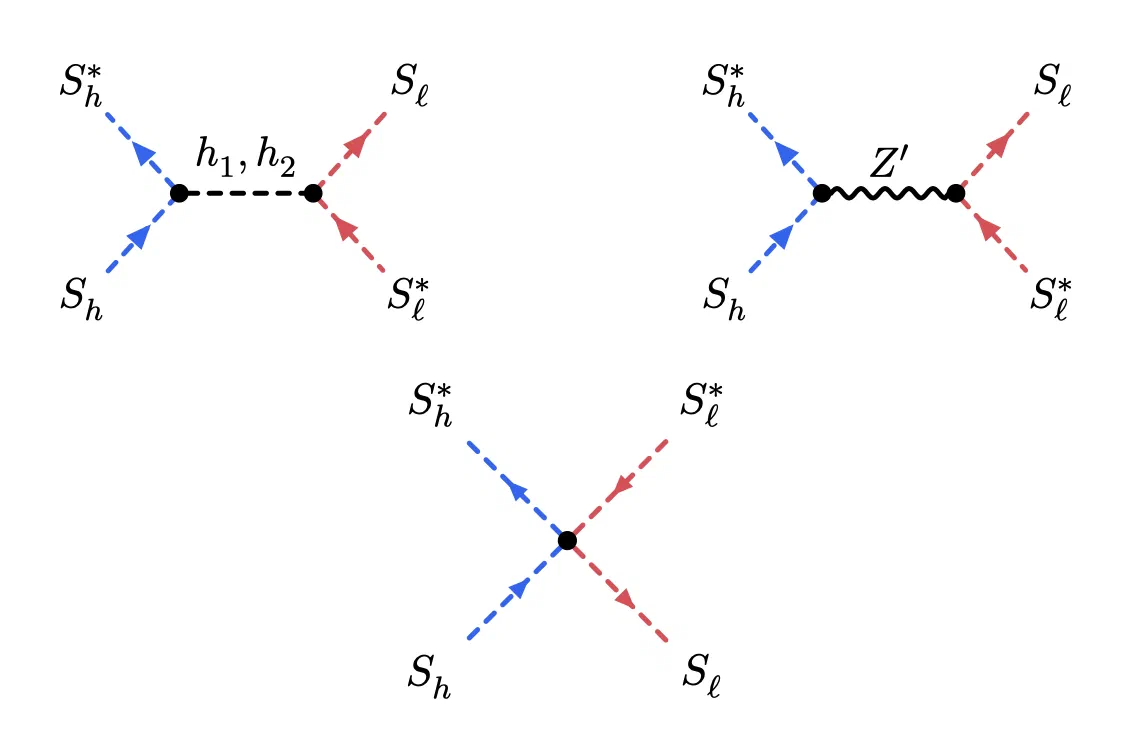
We have studied a two-component pNGB DM model based on a complex scalar field charged under a dark $\mathrm{U}(1)_V$ gauge symmetry and a global $\mathrm{SU}(3)_g$ symmetry which is softly broken to $\mathrm{U}(1)_3\times \mathrm{U}(1)_8$ symmetry. This residual symmetry automatically stabilizes both states and permits the conversion process $S_h^* S_h^{} \to S_\ell^* S_\ell^{}$. The central motivation was to realize a BDM framework within the pNGB paradigm while keeping the heavier component sufficiently abundant today. In the present setup, this scenario is naturally realized. Compared with more generic multi-component portal models, where the relic fractions are often controlled by several independent couplings and viable regions are frequently tied to hierarchical portal choices, the heavier-component abundance in our model follows more directly from the symmetry structure and coupled freeze-out dynamics.
After imposing the constraints considered in this work, namely perturbative unitarity and Higgs invisible decay together with the observed relic abundance, we found parameter regions compatible with these requirements. The relic abundance was computed using micrOMEGAs, showing that conversion remains non-negligible across the representative parameter-space slices studied here.
Phenomenologically, the DM conversion process provides a concrete source of boosted $S_2^{}$ particles. We evaluated their DIS cross section on nucleons and the corresponding flux from compact DM overdensities around black holes. Although the diffuse halo contribution is too small to be observable, black-hole spikes can enhance the flux substantially, especially for Sgr A$^*$, subject to the usual astrophysical uncertainties associated with spike formation and survival. Even so, the expected event rate in a large-volume neutrino detector such as KM3NeT remains low in the benchmark configurations considered here, indicating that near-term detection is challenging. Nevertheless, the model provides a concrete proof of principle that a pNGB dark sector can naturally realize the ingredients needed for BDM and offers a motivated alternative to multi-component setups in which the required heavy or light hierarchy must be arranged more by hand.
This paper is an outcome of the research project titled Searching for ways to probe pseudo-Nambu-Goldstone-boson Dark Matter
