Preprint
Suppressed Direct Detection of Dark Matter from a Non-Invertible Selection Rule
- arXiv
- arXiv:2611.15030
- INSPIRE
- Citations and references
Abstract +
Direct-detection experiments such as LZ, XENONnT and PandaX-4T have found no dark matter signal, so the dark matter–nucleon cross section must be small. Pseudo-Nambu-Goldstone-boson (pNGB) dark matter accounts for this, because its scattering through scalar mediators cancels at zero momentum transfer. The dark matter still needs a mass, so the global symmetry must also be broken explicitly. The cancellation survives only if this breaking is a mass term. Symmetry-breaking quartic couplings, if unsuppressed, give a cross section like that of an ordinary Higgs portal. We asked whether the mass and these quartic couplings can share a common origin that fixes their relative size.
The idea
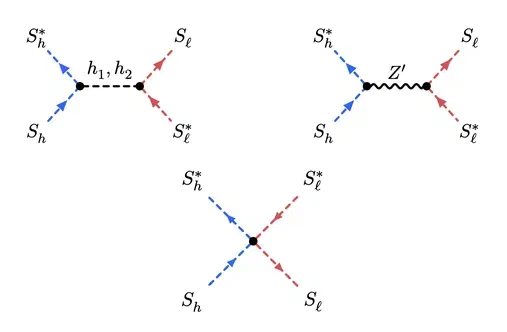
We start from the two-scalar pNGB model of Abe, Hamada and Tsumura. Two complex singlets $\phi_1$ and $\phi_2$ carry the same charge under a dark $\mathrm{U}(1)_V$ gauge symmetry, and a global $\mathrm{U}(1)_a$ rotates them by opposite phases. The Goldstone boson $a$ of this symmetry is the dark matter. We add a heavy real scalar $S$ and assign each field a conjugacy class of the finite group $\Delta(54)$, following the non-invertible selection rule of Kaidi, Tachikawa and Zhang. A coupling is allowed at tree level only when the product of its classes contains the identity.
The rule forbids every renormalizable $\mathrm{U}(1)_a$-breaking term among the light fields, including the dark matter mass term, but allows the coupling $S^2\phi_1^*\phi_2$ to the heavy scalar. Integrating out $S$ at one loop generates the mass and the symmetry-breaking quartic couplings together. The dark matter mass lies a loop factor below the heavy-scalar mass $M_S$, and the quartic couplings are suppressed by $\varepsilon = (m_{\rm DM}/M_S)^2$, which we call the pNGB quality parameter. Taking $\varepsilon \to 0$ restores the symmetry.
Key results
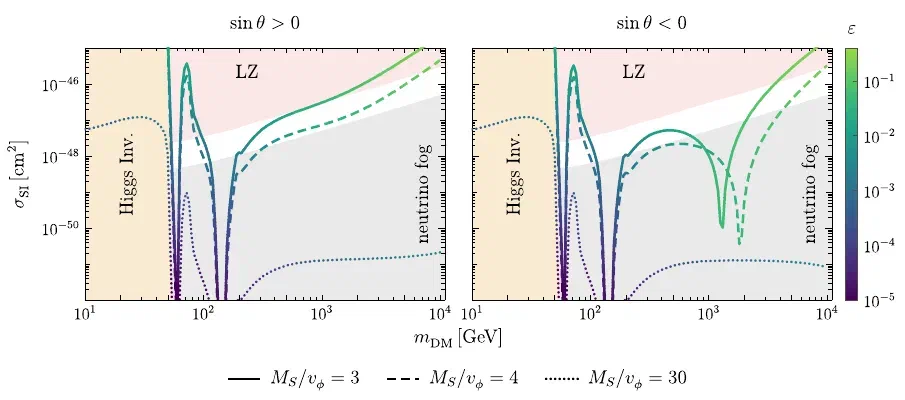
- The induced quartic couplings give the dark matter an effective Higgs-portal coupling through the Higgs boson and a second scalar that mixes with it. The spin-independent cross section vanishes as $\varepsilon \to 0$, and at fixed $M_S$ it grows with the dark matter mass, unlike a Higgs portal with a fixed coupling.
- We fix the dark symmetry-breaking scale $v_\phi$ by the observed relic abundance with micrOMEGAs and follow the cross section from 10 GeV to 10 TeV at fixed $M_S/v_\phi$.
- The window between the LZ limit and the neutrino fog spans less than an order of magnitude in cross section, so it selects a narrow range of $\varepsilon$. For dark matter lighter than the 200 GeV dark gauge boson this requires $\varepsilon \lesssim 10^{-3}$.
- For negative scalar mixing the two mediator contributions interfere destructively. The window then moves to smaller $M_S/v_\phi$, where the pNGB quality is poor, and near the zeros of the effective coupling the dark matter hides below the neutrino fog.
- For $M_S/v_\phi = 30$ the cross section lies deep in the neutrino fog and approaches that of the softly broken model.
Why it matters
The selection rule fixes the size of the symmetry-breaking quartic couplings through $\varepsilon$, so the cross section is a prediction of the model. A signal in the window would therefore point to the heavy-scalar mass $M_S = m_{\rm DM}/\sqrt{\varepsilon}$. A detailed analysis, including a systematic search for groups that realize the mechanism, will follow in a subsequent work.
Share
Read and cite
Paper
Download PDFCitation
More from Publications
- Preprint Exothermic nuclear recoils from thermal quasi-pNGB dark matter Oct 7, 2026 · arXiv:2610.09516
- Preprint Two component pseudo-Nambu-Goldstone-boson dark matter Apr 14, 2026 · arXiv:2604.12435
- Journal article Pseudo-Nambu-Goldstone-boson Dark Matter from Three Complex Scalars Aug 18, 2025 · Journal of High Energy Physics