Exothermic nuclear recoils from thermal quasi-pNGB dark matter

Oct 7, 2026·
Riasat Sheikh
Riasat Sheikh
,
Takashi Toma
,
Koji Tsumura
· 1 min read
PDF Preprint DOI
1 InspireHEP citations
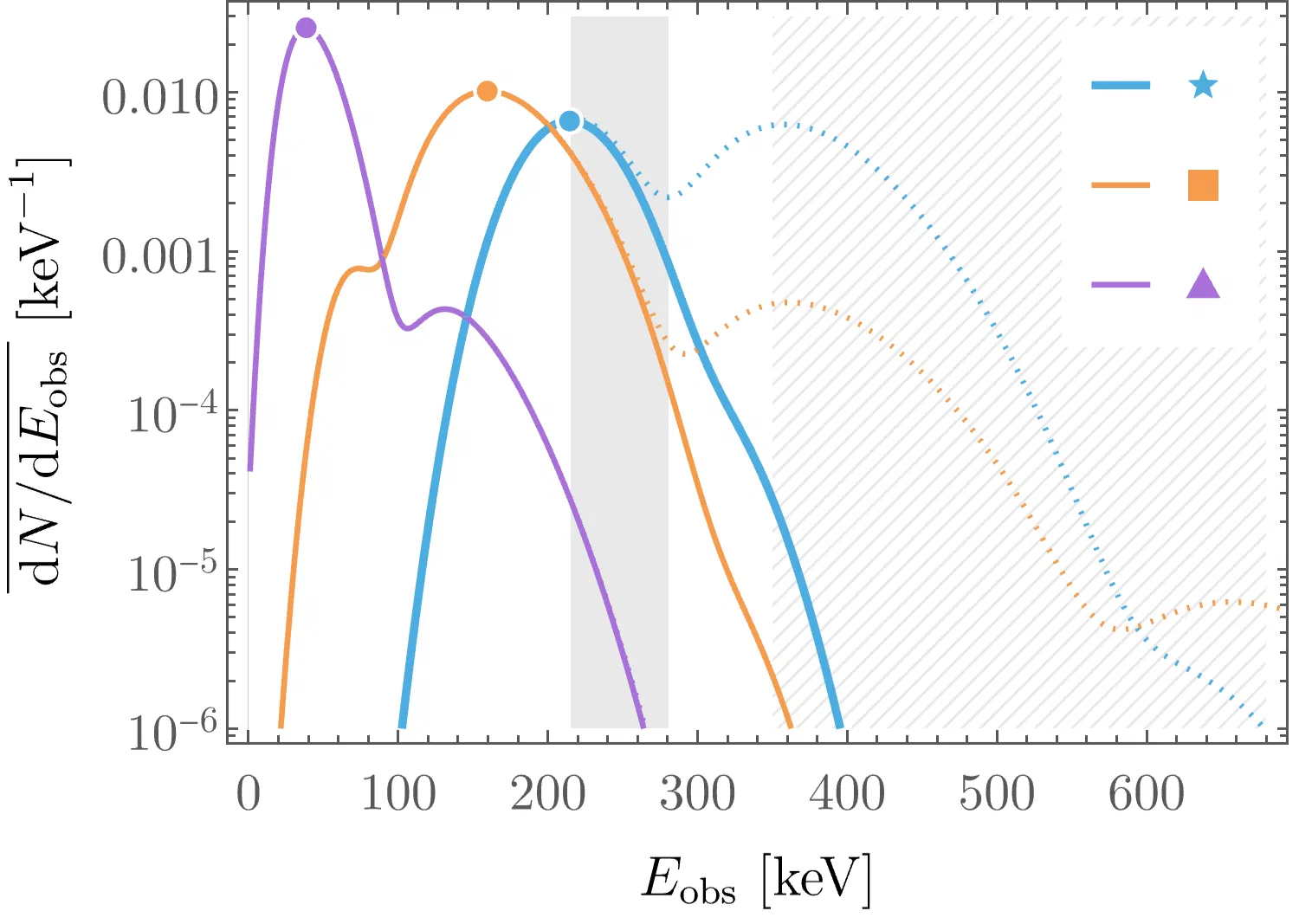
Reconstructed recoil spectra.
Abstract +
We study a two-component dark matter scenario comprising a stable pseudo-Nambu-Goldstone boson (pNGB) and its nearly degenerate long-lived quasi-pNGB partner. An approximate scalar symmetry relates their masses and suppresses the tree-level Higgs-mediated elastic scattering of the excited state through the small mass splitting. Their coupled thermal evolution yields comparable relic populations, while requiring the observed total abundance fixes the dark scalar symmetry-breaking scale and hence the dark gauge coupling. At the studied benchmark, an excited fraction of approximately one half survives under the adopted evolution assumptions. The quasi-pNGB excited state can therefore produce exothermic nuclear recoils despite a suppressed tree-level elastic signal. As an application, we examine the high-energy LUX-ZEPLIN event. For relic compatible parameters, the recoil normalization fixes the kinetic mixing, allowing this interpretation to be tested by independent mediator searches.
publications

We have studied a two-component dark sector containing a stable pNGB $a$ and its nearly degenerate quasi-pNGB partner $s_-$. The approximate scalar symmetry connects the small mass splitting to the suppression of tree-level Higgs-mediated elastic scattering. The coupled thermal calculation yields comparable relic populations, while efficient annihilation into light dark gauge boson $Z'$ reproduces the total abundance. At $\mathrm{BP}_\star$, we have a substantial surviving excited population under the adopted evolution assumptions. These ingredients provide a thermal source of exothermic nuclear recoils with a suppressed tree-level elastic signal.

Applied to the high-energy LZ event, the setup considered here admits a relic-compatible benchmark whose exothermic recoil spectrum provides support at the observed event energy. At $\mathrm{BP}_\star$, the expected sideband yield is comparable to the search-window yield providing a further test through future high-energy recoil measurements. Independent dark gauge boson searches can also test the mixing required by this interpretation.

Riasat Sheikh
Authors
PhD Researcher
I am a PhD researcher in elementary particle theory at Kyushu University, with research interests in dark matter, Higgs physics, and particle phenomenology beyond the Standard Model.