Pseudo-Nambu-Goldstone-boson Dark Matter from Three Complex Scalars


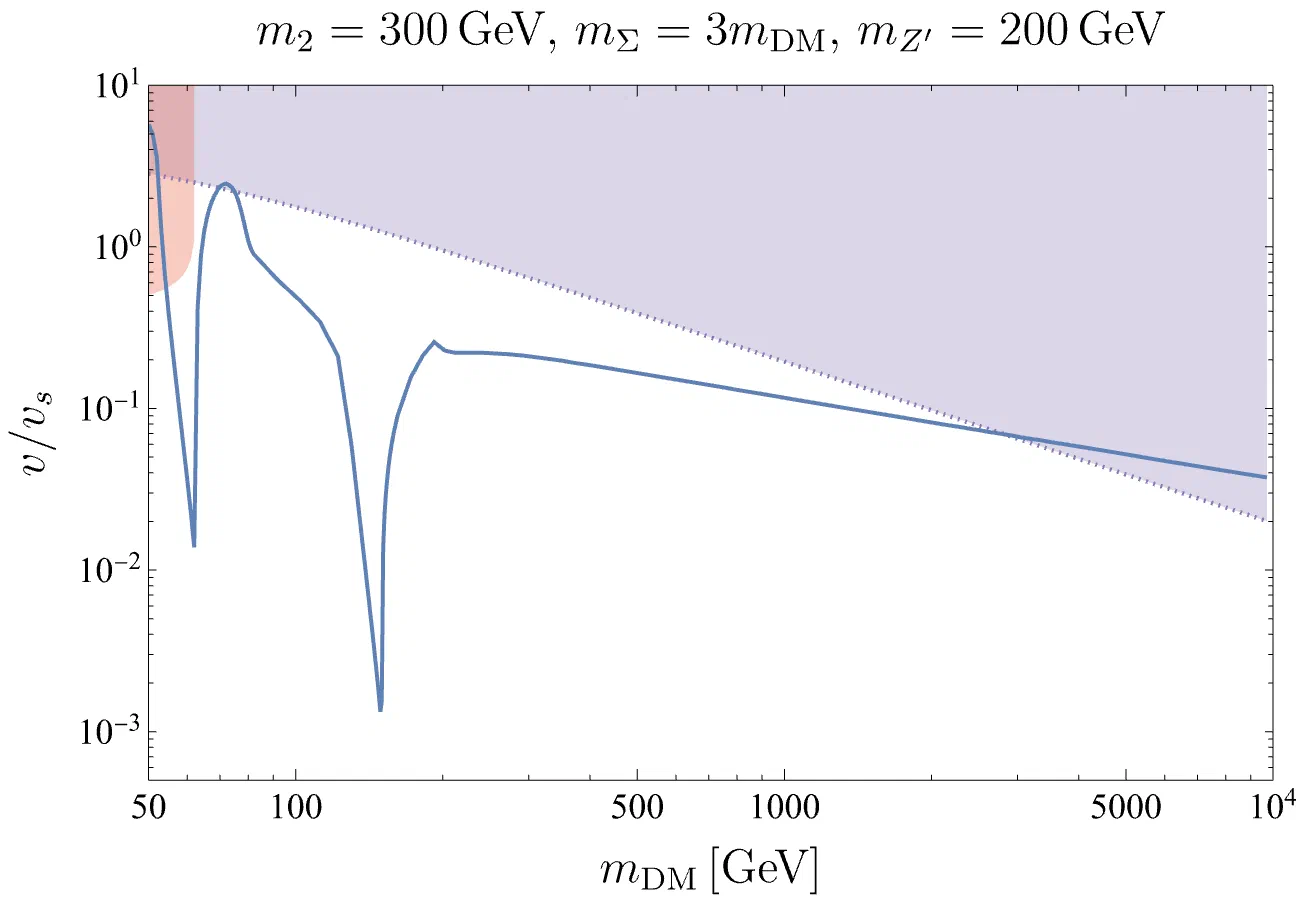 Prediction of viable parameter space.
Abstract +
In this work, we have proposed a pseudo-Nambu-Goldstone boson dark matter model stabilized by a residual $\mathbb{Z}_3$ symmetry, realized through three complex scalar fields charged under a dark $\mathrm{U}(1)_V$ symmetry. The model naturally suppresses direct detection signals via symmetry-induced cancellations and introduces semi-annihilation channels not accessible in $\mathbb{Z}_2$ scenarios.
We examined theoretical and experimental constraints, including perturbative unitarity and Higgs invisible decay bounds, and confirmed that a viable parameter space exists. The relic abundance was computed using $\texttt{micrOMEGAs}$, showing that both annihilation and semi-annihilation processes significantly contribute to determine the relic abundance.
While the model was partly motivated by the possibility of generating boosted dark matter signals detectable at neutrino detectors, we found the resulting cross section to be well below the current experimental sensitivities. Nevertheless, this setup provides a minimal and consistent framework for semi-annihilation-driven pNGB BDM and opens the path for more predictive extensions.
This paper is an outcome of the research project titled Searching for ways to probe pseudo-Nambu-Goldstone-boson Dark Matter
