Effect of quantum gravity on specific heat of solid


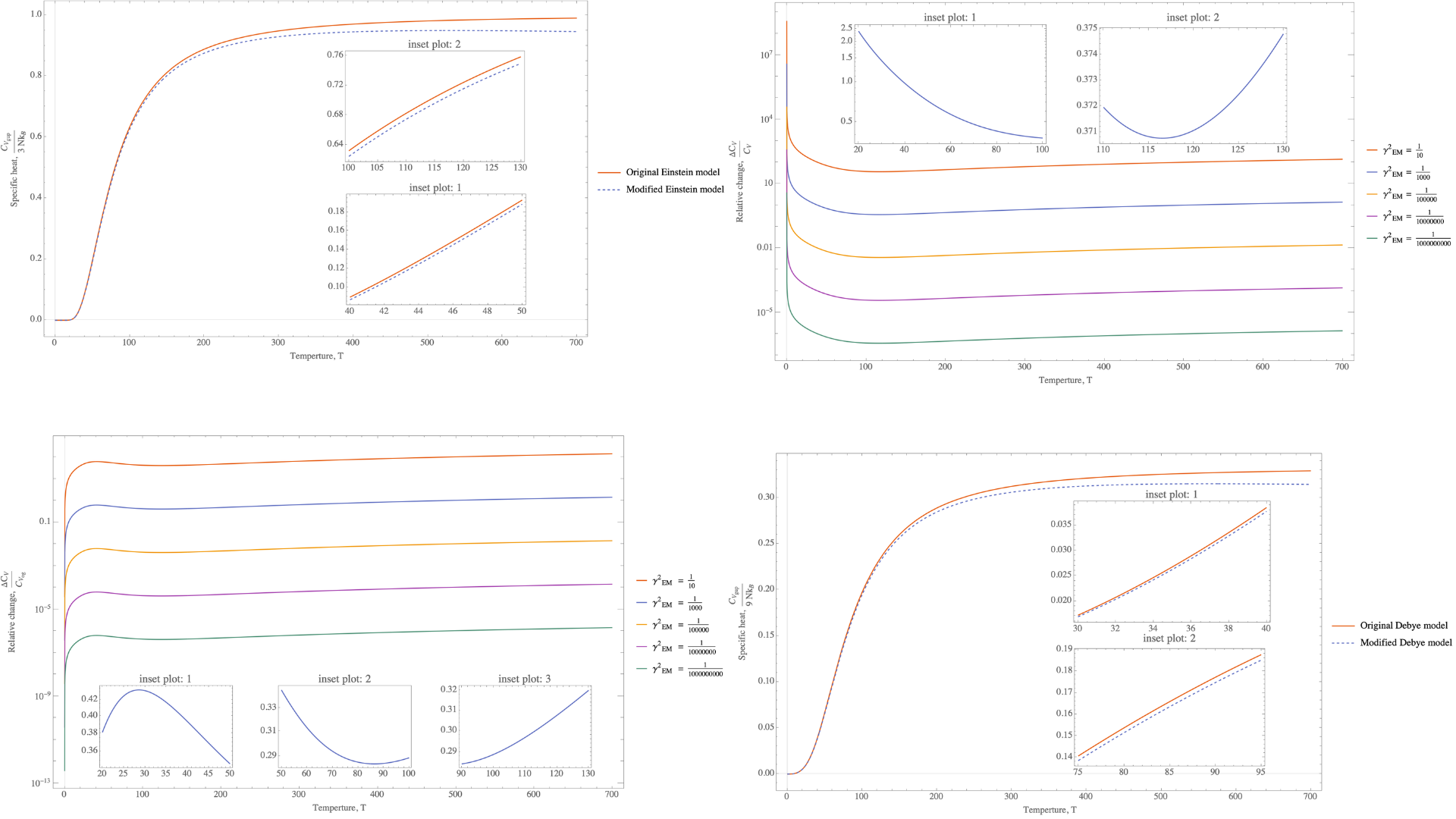
In this paper we have studied the influence of quantum gravity theories on specific heat of solids using both Einstein and Debye model. We obtain the modifications to the specific heat in Einstein’s model using the GUP modified spectrum of QHO. Our results match with the usual expression in the limit $\gamma_\mathrm{EM}^2 \to 0$. The resulting specific heat is found to be less than the standard value at any temperature. In the case of Debye model of specific heat we have checked that the propagation speed of waves in the solid is influenced by the gravity. We calculate the modification to the dispersion relation which depends on amplitude and keeps growing with time. It is also noted that the modification is complex suggesting that some kind of interaction is happening analogous to the electromagnetic waves in an interactive medium. Furthermore, we calculate the modification to the specific heat in Debye’s model which matches the standard value when we ignore the quantum gravity effects. At low temperature, the modification is negative and receives contributions proportional to both $T^3$ and $T^4$. The departure of the heat capacity from the classical value (Dulong-Petit law) at low temperatures is one example of the success of quantum mechanics in describing experimental observations. Thus, the observations here may be used to determine the effect of gravity in the specific heat models of a solid experimentally. However, GUP modifications are extremely small. It will be interesting to study the GUP modified dispersion relation considering the time dependence in the future.
This paper is an outcome of the research project titled Gravity, Minimal Length and Quantum Phenomena

I’m a PhD researcher in elementary particle theory, working on dark matter models, particle phenomenology, and exploring new ideas beyond the Standard Model. My work is driven by a curiosity to understand the universe at its most fundamental level.
Any inquiries, collaboration opportunities, or discussions related to my research are welcome. Feel free to reach out.