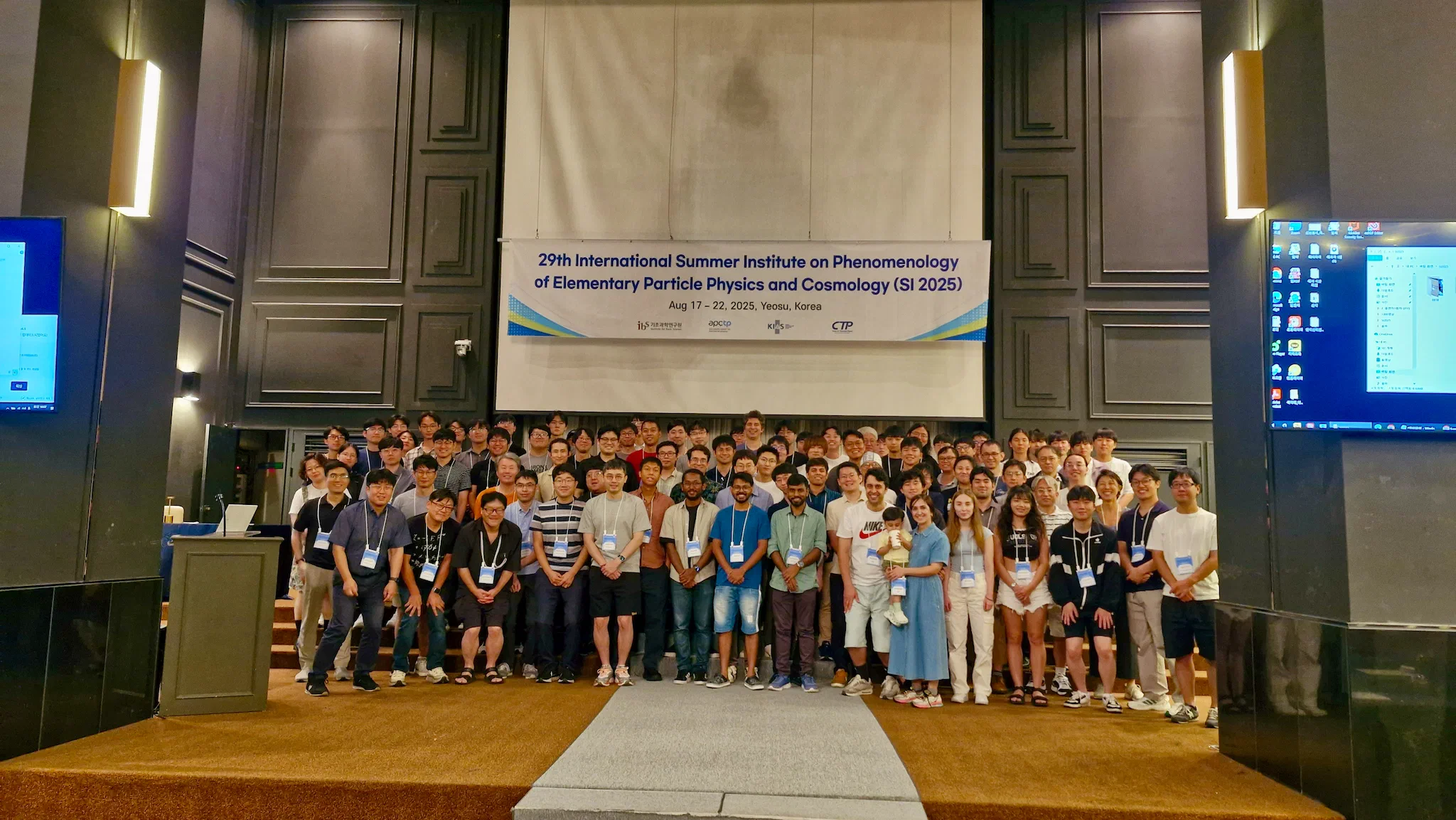
Oral presentation at SI2025 in Yeosu

Date
Aug 21, 2025 2:00 PM — 2:20 PM
Event
Location
UTOP Marina Hotel & Resort
Yeosu, Yeosu, Korea
Abstract +
This study explores a dark matter model in which a pseudo-Nambu-Goldstone boson arises as a viable dark matter candidate from the spontaneous and soft breaking of global $\mathrm{U}(1)$ symmetries and stabilized by a residual $\mathbb{Z}_3$ discrete symmetry. The model introduces three complex scalar fields, singlets under the Standard Model gauge group, and charged under a dark $\mathrm{U}(1)_V$ gauge symmetry together with a permutative exchange symmetry among three scalars. These features naturally suppress the dark matter–nucleon scattering cross section by its Nambu-Goldstone boson nature. In addition to conventional annihilation channels, the $\mathbb{Z}_3$ structure allows semi-annihilation processes, playing a crucial role in setting the relic abundance. We analyze theoretical and experimental constraints, including relic abundance, Higgs invisible decays, and perturbative unitarity, and evaluate the elastic scattering cross section for boosted dark matter.
I gave a short talk, “Searching for ways to probe pseudo-Nambu-Goldstone boson dark matter,” at SI2025 in Yeosu. The presentation was based on our published work 1.
It was a valuable opportunity to present this work, receive feedback, and interact with researchers working in particle phenomenology and cosmology.
Here are a few moments from the event.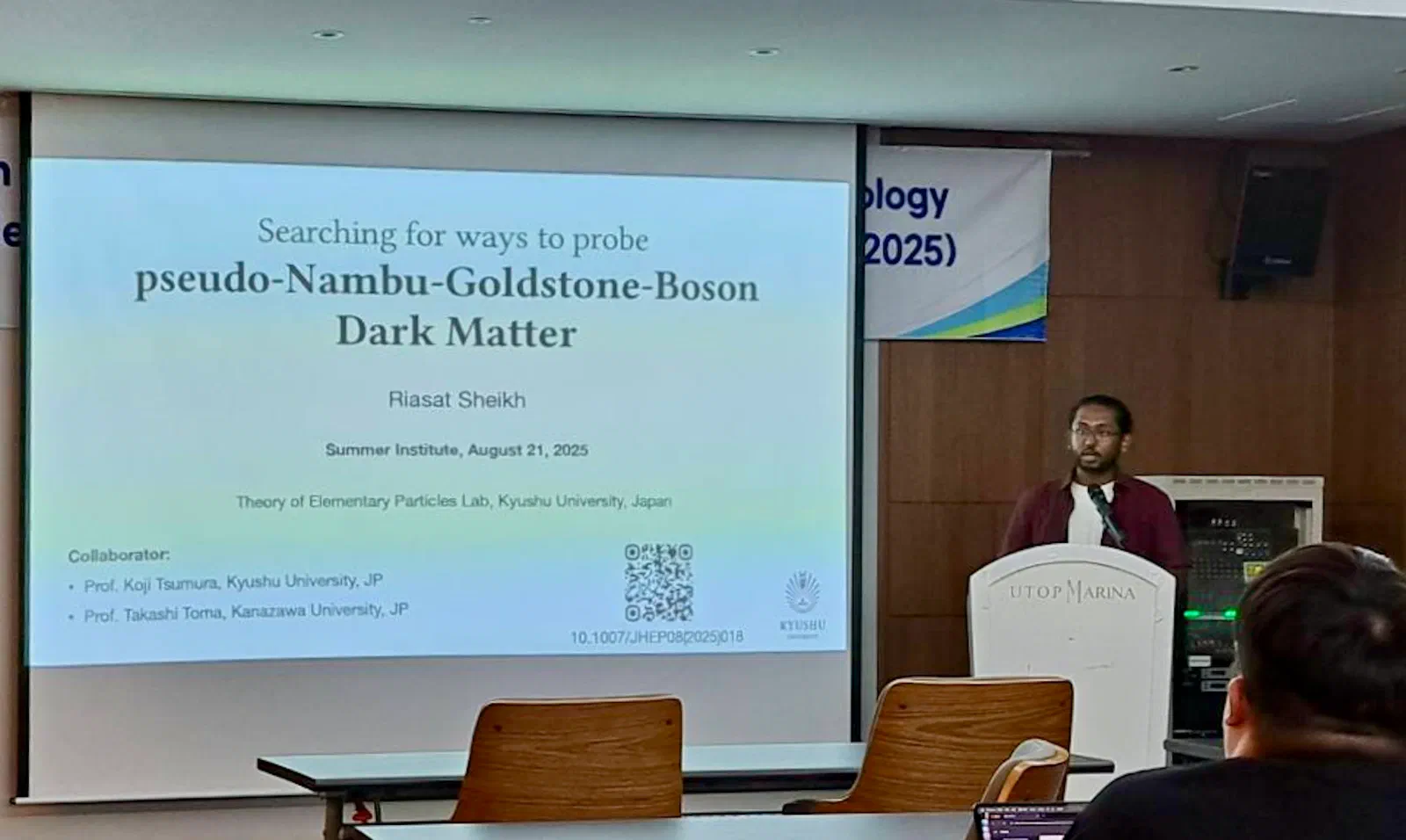



, Pseudo-Nambu-Goldstone-boson Dark Matter from Three Complex Scalars , JHEP (2025) , DOI [arXiv:2504.19886] . ↩︎
